Hammond, Louisiana

Sewer line repair in Hammond, LA: compare the options

Iron is a repair-options guide for homeowners considering sewer line repair in Hammond, LA. Compare a located repair, replacement and trenchless proposals against the inspection findings. The matrix helps you distinguish retained pipe, access and restoration, then carry clear questions into a written scope with a qualified professional and the serving utility.

Last reviewed: November 16, 2026

Compare repair options
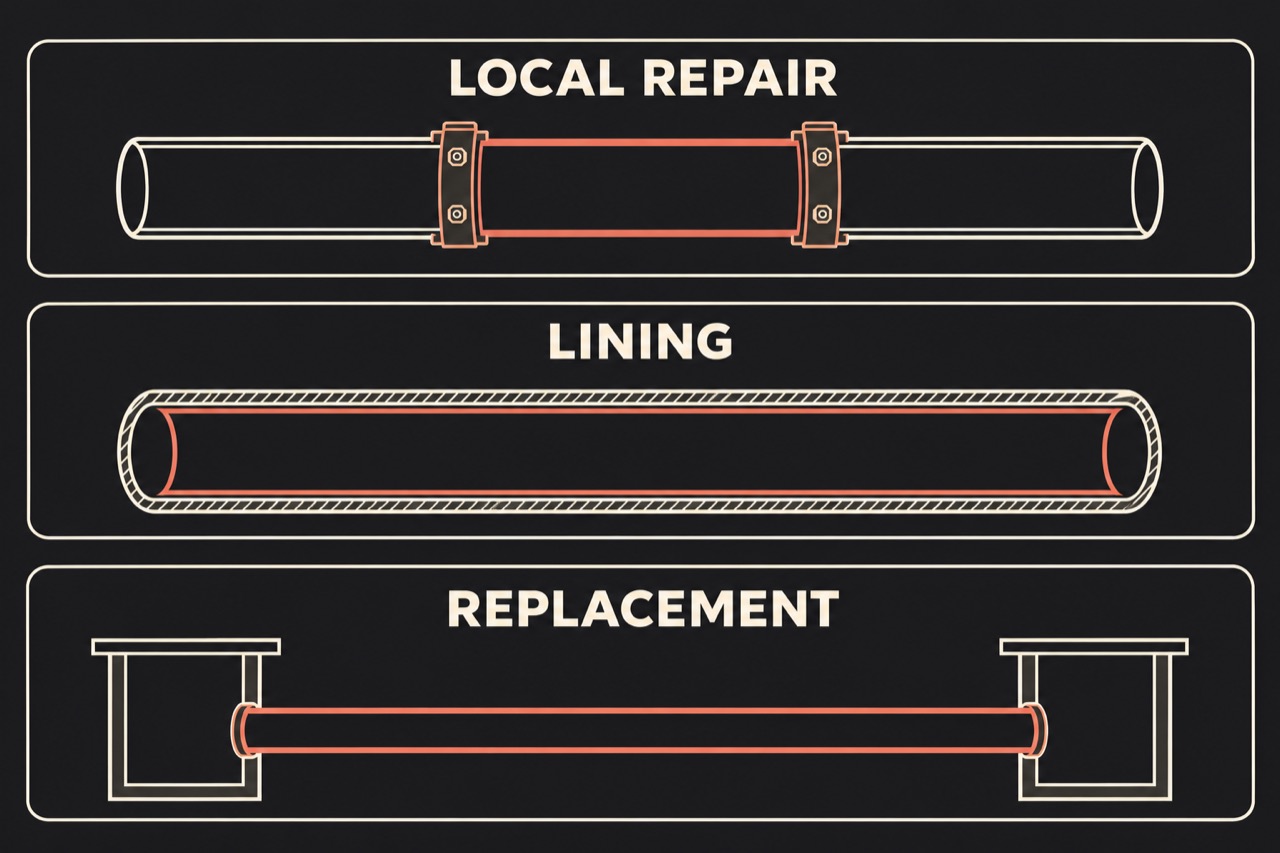
Conceptual diagram comparing a short repair, an inner lining and pipe replacement with access pits.

Conceptual method comparison; access and suitability depend on the inspected pipe.

Start with the evidence.

Repair, replacement and trenchless work are different ways to address a problem. The right discussion begins with what an inspection actually found.

Look at the whole line, not just the problem spot.

A clear inspection record helps you understand the proposed work and what remains outside it. Ask the provider to walk you through these four things.

Condition

What was found, and how was it identified?

Extent

Where does the problem begin and end?

Access

How can the line and its connections be reached?

Unknowns

What could not be seen or confirmed yet?

Compare the proposed repair.

Use the same questions for each option. The table does not select a method; it makes the scope, access and open questions easier to discuss.

Questions to compare with a qualified provider
What to compareLocalized repairReplacementTrenchless approach
Observed problemLocalized repairLocated defect and its position.ReplacementFindings across the proposed length.Trenchless approachDefects this technique can address.
Supporting evidenceLocalized repairInspection record and location.ReplacementLine and connection condition.Trenchless approachHost pipe, route and connections.
Proposed scopeLocalized repairRepair limits; pipe retained.ReplacementNew pipe start and finish.Trenchless approachNamed method; pipe retained or replaced.
Access areaLocalized repairRepair access and excavation.ReplacementTrench, pits and tie-ins.Trenchless approachEntry points and access pits.
RestorationLocalized repairDisturbed surfaces and restoration owner.ReplacementPaving and planting along the route.Trenchless approachSurface work around each access.
Remaining unknownsLocalized repairCondition beyond the repaired section.ReplacementRoute, connections and maintenance boundary.Trenchless approachBends, host condition and branches.
Final completionLocalized repairIncluded completion checks.ReplacementNew section and connection checks.Trenchless approachFinished pipe and connection checks.

A localized repair can be open-cut or trenchless; trenchless methods can also replace pipe. See the EPA's service lateral rehabilitation overview.

From finding to finished work.

A useful scope connects the inspection to the work on the property, then to the records that show what was done.

  1. Review the findings

    Locate the problem and ask for the inspection record and its limits.

  2. Agree on the scope

    Compare the method, boundaries of work and remaining unknowns.

  3. Plan access

    Confirm utility locating, permissions, any required permits and restoration.

  4. Check the result

    Ask what completion checks and records are included when the work is complete.

The actual sequence depends on the property, utility and work proposed.

Explore repair vs. replacement

Before the ground is opened.

Confirm the serving utility and the work area for the property. Ask who will arrange locating and which approvals or inspections apply to the proposed work.

Private underground lines may need separate locating; an 811 request does not necessarily identify every private line.

Useful local starting points

Louisiana 811 private locating guidance explains why some privately owned lines may not be marked.

Hammond Building can help with city permitting questions. For work involving the public sewer, confirm the scope and current requirements with the city.

What price range helps frame the options?

For national context, Angi’s July 9, 2026 guide lists $1,100–$4,100 for sewer-line repair and $50–$250 per linear foot for digging and replacement. Neither figure is a Hammond average or an offer from Iron. Compare the quoted length, access work and surface restoration before treating two totals as prices for the same scope.

Angi national cost guide, July 9, 2026

Evidence behind the guide

Code reference: Hammond Code Supplement 26, online update December 18, 2025. Newer ordinances may be absent; confirm current application with the city.